
The Judgment of Paris (or the backstory to the Iliad and the Odyssey)

Scene of the Judgment of Paris, stone and glass tesserae in many colors, and limestone, from the triclinium of the Atrium House, Daphne (Antioch), early second century CE, L: 196 cm W: 196 cm D: 15 cm, Louvre Museum, Paris, Ma 3443
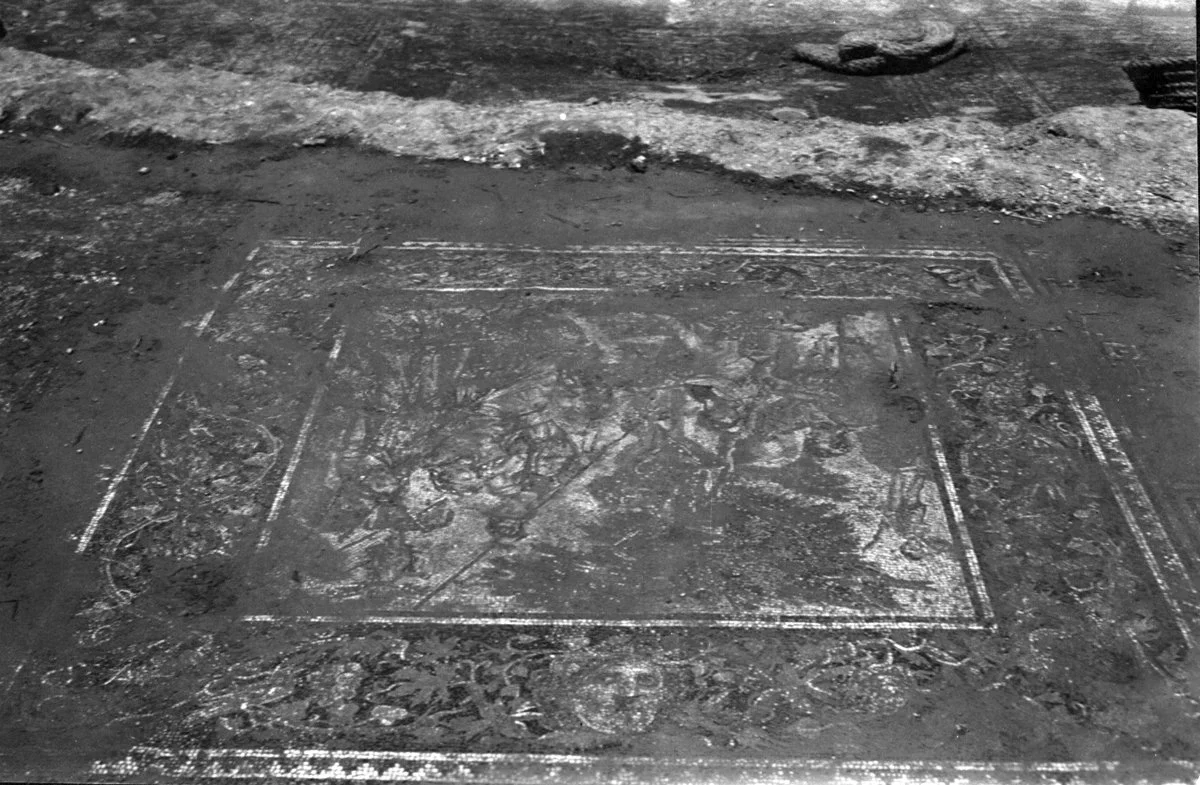
Scene of the Judgment of Paris, in situ, stone and glass tesserae in many colors, and limestone, from the triclinium of the Atrium House, Daphne (Antioch), early second century CE.
Excavated in 1932, this mosaic fragment from the Atrium House at Daphne depicts the Trojan shepherd-prince Paris rendering judgment on the beauty of the goddesses Hera, Athena, and Aphrodite. The fragment is now in the collection of the Louvre Museum as part of the distribution of lifted mosaic fragments per the excavation agreement in the 1930s. The scene depicts an event that precedes the outbreak of the Trojan War and thus the stories of both Homer’s Iliad (the war) and the Odyssey (the homecoming). It all began with a snub. Excluded from the wedding of Peleus and Thetis (who later became the parents of the Greek warrior Achilles), the goddess Strife (Eris) avenged this insult by lobbing a golden apple inscribed “most beautiful” into the party. Recognizing the losing proposition that this choice presented, Zeus declined to adjuciate to whom such an apple and accompanying superlative status should be awarded and, instead, passed the buck to Paris, a Trojan prince.
Pictured here seated on a rock within a verdant, rocky landscape, Paris, dressed in long sleeves and trousers, looks at the messenger god Hermes, who leaning towards him at left. Opposite them stand the trio of goddesses—Athena (identified by her helmet and breastplate), Hera (seated at center with her hair covered by a white veil), and Aphrodite (adorned in bright blue and rich gold), awaiting Paris’s judgment. As the story goes, each goddess offered Paris something in exchange for being chosen and in Aphrodite’s case, that was another man’s wife, Helen, wife of Spartan king Menelaus, who was her human counterpart in beauty. Paris gives Aphrodite the golden apple and receives Helen in exchange, setting in motion the decade-long war between the Greek-speaking allies and the Trojans.
This mosaic fragment was displayed as part of the traveling exhibition Antioch: the lost ancient city (2000) and at that time underwent considerable conservation analysis, identifying over twenty-five different colored stones. Led by Dr. Christine Kondoleon, the curatorial team behind that exhibition also brought this fragment back into connection with other pieces of the Atrium House, including two fragments of a dancing maenad and a dancing satyr now in the collection of the Baltimore Museum of Art, and the scene of Herakles and Dionysos in a drinking contest now in the collection of the Princeton Art Museum. Caroline Cerilli (JHU ‘22) studied the dancing maened and you can read about and listen to Caroline’s analysis here.

Mosaic fragments from the Atrium house in situ, Daphne (Antioch), 1932. Courtesy Princeton Archive
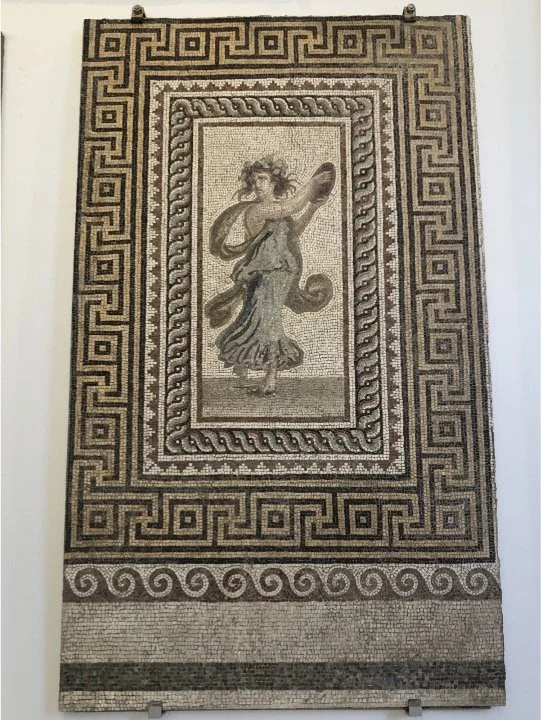
Mosaic fragment of a dancing maenad, Atrium House, Daphne(Antioch). ~2nd c CE. Baltimore Museum of Art.
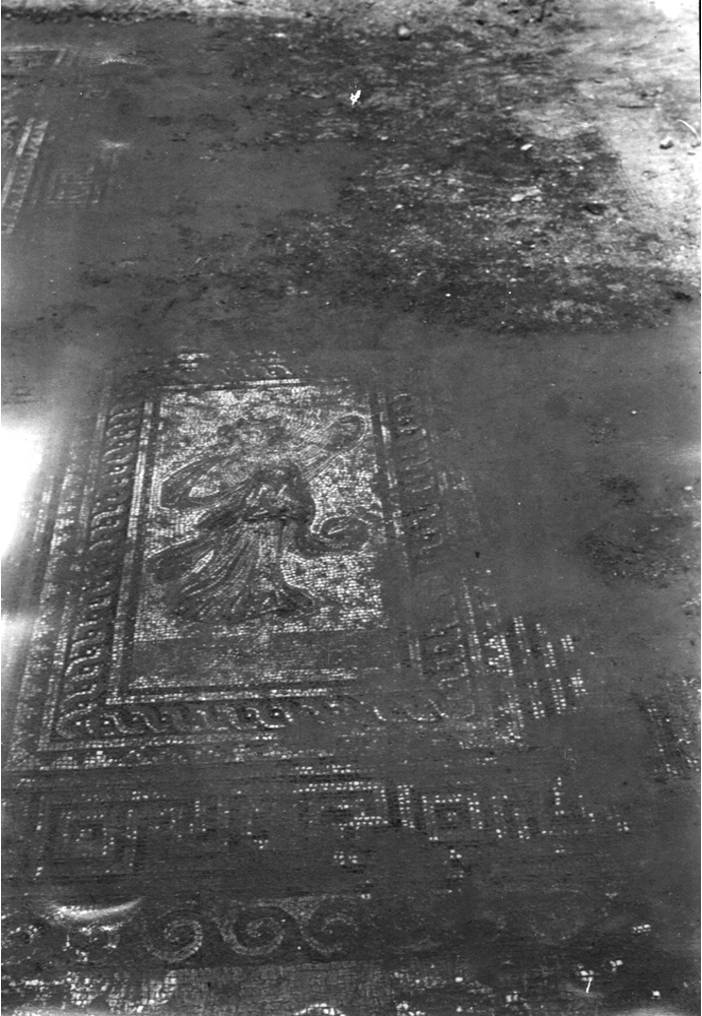
Mosaic floor depicting a dancing maenad, in situ, Daphne (Antioch), ~2nd c CE. 1932
The juxtaposition of the central, vibrantly polychrome scene of the Judgment of Paris with the drinking contest between Dionysos and Herakles flanked by a dancing satyr and maenad takes us into the performance world of this Roman house, where song, dance, and live performance likely took place in space for which these mosaics served as the floors, bringing together living performers and images from ancient poetry and myth that had by the time this floor was laid down already been in circulation for a millennium across the wider Mediterranean. The Atrium house, thus, constitutes an ancient form of classical reception, already active in the 2nd century CE.